

Visual storytelling gifts for partners: how to make them pause
Visual storytelling turns a gift into a relationship signal. When a recipient unwraps something and recognises a specific memory, a private joke, or a moment only the two of you share, they pause. That pause is the whole point. It’s the instant they understand the gift was made for them, not just for someone like them. Radioactivelove builds its entire product range around that moment, and the research backs the approach: according to Sendoso, 87% of decision-makers said a handwritten note made a gift feel more personal.
In this guide, you’ll find:
- The emotional mechanics behind storytelling gifts and why they outperform price
- The best formats for romantic, long-distance, and close-friend occasions
- A step-by-step workflow from memory to finished product
Table of Contents
- Why does visual storytelling deepen emotional connection?
- Which formats carry a visual narrative most effectively?
- How do you design a storytelling gift that actually lands?
- How do micro-format gifts keep the story going?
- Radioactivelove brings visual storytelling to life
- Key takeaways
- Why the narrative bridge is the part most people skip
Why does visual storytelling deepen emotional connection?
The pause moment is the most powerful outcome a personalised gift can produce. It outweighs price, packaging, and brand prestige. When a recipient sees a specific image, colour palette, or sequence that references their story, the brain registers attention and care before a single word is spoken.
A story-driven gift needs four components to work: a trigger moment (the memory that anchors the gift), a recipient detail (something only they would recognise), a written note (the narrative bridge), and a follow-up that keeps the story alive. Miss any one of these and even a beautifully designed object can read as generic.
87% of recipients say a handwritten note lifts a gift’s perceived personal value. That single addition costs nothing and prevents the most common failure mode: a well-designed item that the recipient can’t decode without context.
Pro Tip: Always attach a one-paragraph narrative bridge to any visual gift. Without it, even a beautifully sequenced photo display can feel like a decorative object rather than a message.
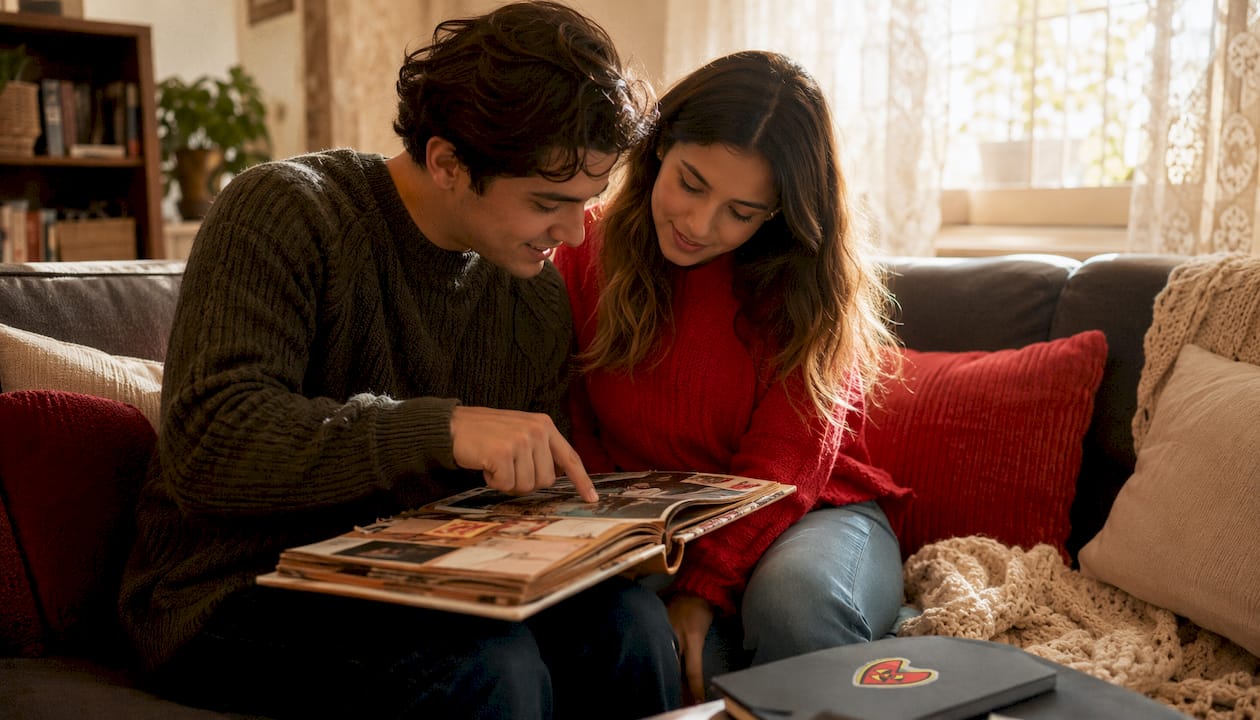
The importance of storytelling gifts comes down to one thing: the recipient feeling genuinely seen. Price signals effort; a story signals understanding.
Which formats carry a visual narrative most effectively?
Photo keepsakes, flipbooks, custom animations, video-integrated displays, collages, micro-zines, and ritual cards are the most versatile formats for narrative-led gifting. Each one suits a different relationship dynamic and occasion.
| Format | Best use case | Emotional effect | Est. production time | Ballpark Canadian cost |
|---|---|---|---|---|
| 3D Crystal Ball Video Player | Long-distance, anniversary | Moving memory, high intimacy | 7–14 business days | — |
| Custom photo flipbook frame | Anniversary recap, shared history | Paced, tactile narrative | 7–14 business days | — |
| Photo collage print | Long friendship history, milestone | Warmth, nostalgia | 2–5 business days | — |
| Warm crystal night light | Ongoing romantic ritual | Ambient, soft keepsake | 7–14 business days | — |
| Micro-zine or ritual card | Close friend, low-key occasion | Intimate, repeatable | 1–3 business days | — |
Production times and cost ranges are planning estimates; confirm with your supplier at order.
Quick format decision rules:
- Choose a flipbook or animation frame when the story has a clear beginning, middle, and end — anniversaries, a year-in-review, a trip recap.
- Choose a 3D Crystal Ball Video Player when the recipient is far away and you want the gift to feel like presence, not just a photo.
- Choose a micro-zine or ritual card when the occasion is low-key but the feeling is not — a “thinking of you” that lands harder than a text.
Design elements shape how a story reads: collages suit long shared histories, moody colour treatments work for intense memories, and bright palettes fit celebratory stories. For moving formats like flipbooks or video displays, sequencing and pacing matter as much as image selection.
Radioactivelove’s Custom Photo Flip Book Frame and 3D Crystal Ball Video Player Glass Ball are purpose-built for exactly these use cases. Both ship to Canada. If sustainable materials matter to you, check product descriptions for wood sourcing and packaging details before ordering.
How do you design a storytelling gift that actually lands?
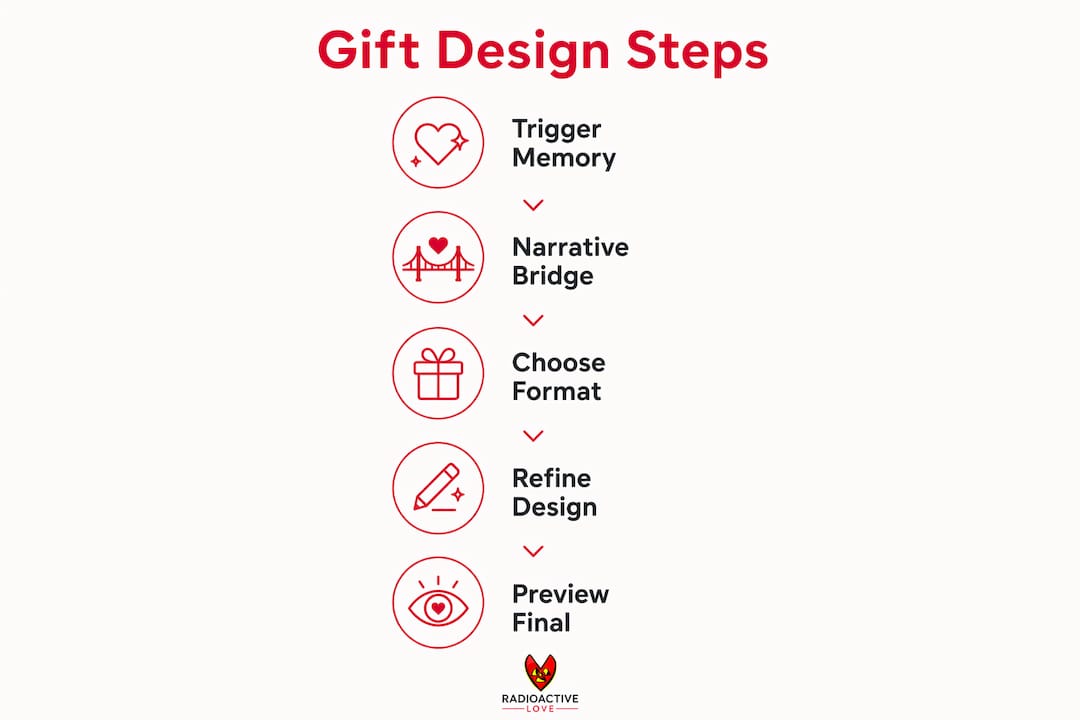
The five-step process is: choose the trigger memory, translate it into a narrative, pick the right format, refine the design, then finalise production and presentation. Each step is short, but skipping one is where most gifts go flat.
1. Choose the trigger memory. Pick one specific moment, not a general feeling. “The night we got lost in Banff” beats “all our travels.” Specificity is what creates the pause.
2. Write a one-paragraph narrative bridge. Before you touch any design tool, write a short paragraph about why this memory matters. Starting with a written story amplifies perceived value more than premium packaging. This paragraph becomes your caption, your card note, or your design brief.
3. Pick the format that matches emotional intent. A video ball for presence and movement; a flipbook for a paced, tactile story; a collage for breadth. Match the format to the feeling, not just the budget.
4. Refine layout, colour, and sequencing. Translating a memory into a structured visual object means choosing an anchor image (the single strongest visual), a colour mood that matches the memory’s tone, and a sequence that builds toward the emotional peak. For flipbooks and video formats, place the most resonant image near the end, not the beginning.
5. Finalise production and presentation. For Canadian buyers, build in 7–14 business days for custom production plus standard shipping. Order earlier for peak seasons (December, Valentine’s Day, Mother’s Day). Present the gift in a quiet moment, not mid-party. Silence before the reveal often lands better than a scripted line.
Common pitfalls to avoid:
- Over-personalisation that feels intrusive (inside references the recipient finds uncomfortable)
- Missing the narrative bridge entirely
- Logo-heavy or brand-first packaging that centres the sender, not the story
Pro Tip: Before placing a full order, request or mock up a single-frame preview image. If the emotional clarity isn’t obvious from one frame, the full product won’t fix it.
For more on how custom gifts mark anniversaries, the emotional logic holds across occasions.
How do micro-format gifts keep the story going?
Micro-format gifts convert gifting from a one-time gesture into an ongoing practice. A small, intentional item paired with a narrative bridge costs little but signals consistent attention, which is what sustains closeness in long-distance relationships and long-term friendships alike.
Micro-format ideas:
- A single-photo ritual card with a one-sentence caption
- A 3D Pop-Up Cherry Blossom Greeting Card with a handwritten line
- A short custom audio message attached to a physical object
- Monthly tiny mementoes (a pressed flower, a ticket stub, a printed photo)
- Small digital add-ons like a 3-minute voice note or a single-page zine
A practical ritual template: send three small gifts across a year at meaningful intervals (the anniversary of when you met, a mid-year “just because,” and a year-end recap). Each one references the last. By the third, the recipient isn’t just receiving a gift; they’re reading a continuing story.
On frequency: more than one micro-gift per month risks making the practice feel like a subscription rather than a gesture. The goal is novelty within a recognisable ritual, not volume.
Pro Tip: Use a repeatable cue across every micro-gift: the same envelope colour, the same opening line, the same small symbol. It signals continuity and makes each item feel like a chapter, not a standalone.
Social gifting platforms can complement physical micro-formats. Understanding social gifting helps when coordinating group contributions to a larger narrative gift.
Radioactivelove brings visual storytelling to life
Radioactivelove offers products built specifically to carry visual narratives, not just display photos. The flagship is the 3D Crystal Ball Video Player Glass Ball: a 2.7-inch electronic display inside a crystal sphere that plays a custom video memory on loop. For long-distance couples or anyone marking a milestone, it’s the closest thing to bottling a moment.
The Custom Photo Flip Book Frame sequences your photos into a hand-cranked tactile story, ideal for anniversary recaps or a year of shared memories. The Warm Crystal Night Light works as an ambient keepsake, a soft glow that holds a memory without demanding attention. Each product ships to Canada with customisation options built into the order process.
Browse the full range at Radioactivelove and order your personalised storytelling gift directly from the product page.
Key takeaways
Visual storytelling gifts work because they create a recognition moment: the recipient pauses, understands the gift was made specifically for them, and feels genuinely seen.
| Point | Details |
|---|---|
| The pause is the goal | Every design decision should serve the moment of recognition, not decoration. |
| Four components are required | Trigger memory, recipient detail, written note, and follow-up keep a gift from feeling transactional. |
| Format follows feeling | Match the format to emotional intent: video ball for presence, flipbook for paced narrative, micro-format for ritual. |
| Plan ahead for Canada | Allow 7–14 business days for custom production plus shipping; order earlier for peak seasons. |
| Radioactivelove | The 3D Crystal Ball Video Player and Custom Photo Flip Book Frame are purpose-built narrative formats that ship to Canada. |
Why the narrative bridge is the part most people skip
Most gifting advice focuses on the object. Pick the right product, choose a good photo, get it engraved. What it consistently underweights is the written note, the one-paragraph explanation of why this memory, why now, why you. That note is what separates a gift that produces the pause from one that produces a polite “thank you.”
The four-component framework (trigger, recipient detail, written note, follow-up) sounds simple because it is. The difficulty is that writing the note forces you to articulate something you might prefer to leave implied. That discomfort is the point. The effort of writing it is exactly what the recipient feels when they read it.
For couples in long-distance relationships, this matters even more. A video ball or a flipbook travels well. A handwritten note travels better. The combination is what makes a gift feel like the sender was in the room.
The role of custom gifts in intimacy is not about spending more. It’s about saying something specific enough that only one person on earth could have received it.